

Growing cucumbers on a balcony without a trellis sounds like a compromise. It is not. I spent my first cucumber season fighting with a trellis that kept tipping over in the wind, scratching my railing, and taking up half my floor space.
The second season, I ditched it entirely — and harvested more cucumbers than the first year. Here is what nobody tells you: cucumbers do not need a trellis. They need support — and on a balcony, there are four better ways to provide it without drilling a single hole or buying any structure
Here is what nobody tells you: cucumbers do not need a trellis. They need support — and on a balcony, there are four better ways to provide it without drilling a single hole or buying any structure.
Why Most Balcony Cucumber Advice Gets This Wrong
Every guide online tells you to build or buy a trellis. Most of those guides are written for backyard gardens where you have soil to anchor a trellis, fence posts to lean it against, and space to let it fall over without destroying everything else.
A balcony is different. Your floor space is limited. Your railing cannot always support a freestanding structure. Wind on upper floors can topple a top-heavy trellis and take your entire cucumber plant with it.
The solution is not a better trellis. The solution is choosing the right cucumber variety and the right growing method for a balcony specifically.
Step 1 — Choose the Right Variety (This Decides Everything)
This is where most balcony gardeners fail before they even start. They buy vining cucumber seeds, watch them grow eight feet long, and then wonder why they need a trellis.
Trellis-free balcony cucumber growing only works reliably with bush varieties. These form compact vines of two to three feet rather than the eight-foot runners of standard vining types.
Also Read: 10 Exotic Vegetables for West-Facing Balcony That Thrive in Intense Heat
Best bush cucumber varieties for trellis-free balcony growing:
Bush Champion — The most reliable bush variety for containers. Compact vines, heavy producer, fruits reach 8 inches. Widely available at US garden centres.
Spacemaster — Specifically bred for small spaces. Vines stay under 3 feet. Produces full-sized cucumbers consistently. Excellent disease resistance.
Patio Snacker — Compact plant with small snacking cucumbers. Perfect for hanging baskets and cascade growing. One of the most productive per square foot of any balcony vegetable.
Bush Pickle — If you want pickling cucumbers, this is the trellis-free option. Very compact, extremely productive, fruits ready faster than slicing types.
What to avoid: Any seed packet that says “vining,” “climbing,” or does not specify bush type. Standard varieties like Marketmore and Straight Eight will overwhelm a trellis-free balcony setup within weeks.
Step 2 — Pick Your Trellis-Free Growing Method
Once you have a bush variety, you have four methods that work on a balcony without any freestanding structure.
Method 1: Cascade Growing — The Simplest Approach

Place your pot on a balcony ledge, table, or elevated surface. Let the vines trail naturally downward over the edge rather than trying to grow them upward.
Bush cucumber vines at two to three feet long cascade beautifully over the sides of large containers. The fruit hangs freely, grows straighter than fruit sitting on soil, and is easy to spot and harvest.
What you need: A container of at least 5 gallons placed at an elevated height. The vines do the rest.
Best variety for this method: Patio Snacker or Bush Champion.
The one thing to watch: Wind. Cascading vines on upper-floor balconies catch wind and can stress the plant. If your balcony is consistently windy, this method works better with the pot positioned against a wall rather than at the open railing edge.
Method 2: Balcony Railing as Natural Support

Your balcony railing is already a support structure. Most gardeners ignore it entirely.
Place your pot directly against the railing. As the bush cucumber vines grow, loosely weave them through the railing bars using soft garden ties or strips of old t-shirt fabric. The railing provides horizontal support without any additional structure needed.
This works best on balconies with vertical bar railings rather than solid panel railings, as the vines can weave through and grip naturally.
What you need: A pot placed flush against the railing, soft ties, fifteen minutes every few days to guide the new growth.
Best variety for this method: Spacemaster — its compact vines are easy to manage along a railing without overwhelming the space.
Method 3: Tomato Cage in the Pot

A tomato cage placed inside the pot gives enough support for a bush cucumber without the footprint or wind vulnerability of a freestanding trellis.
A standard 3-foot tomato cage fits inside a 5-gallon container. The cucumber vine grows up and through the cage rings naturally. No tying needed beyond the first few weeks of guidance.
This is the most reliable method for anyone who wants some upward structure without a dedicated trellis system.
What you need: One 5-gallon or larger pot, one 3-foot tomato cage, a bush cucumber variety.
Best variety for this method: Bush Champion — its vines fill a tomato cage perfectly without outgrowing it.
Method 4: Hanging Basket Growing

This method is completely trellis-free and works on balconies with almost no floor space.
Plant one Patio Snacker cucumber in a 12-inch or larger hanging basket. The vines trail downward naturally as the plant grows. Fruit develops hanging freely below the basket.
The key requirement is consistent watering — hanging baskets dry out faster than floor pots, sometimes twice daily in peak summer. If you can commit to checking moisture twice a day, hanging basket cucumbers produce a surprisingly heavy harvest in a very small footprint.
What you need: A 12-inch-minimum hanging basket, a coconut coir liner for moisture retention, and a daily watering commitment.
Best variety for this method: Patio Snacker only — other varieties get too heavy for hanging basket growing.
Pot Size, Soil, and Feeding — Get These Right
The variety and method matter. These three things determine whether your plant actually produces cucumbers.
Pot size: Minimum 5 gallons for any bush cucumber variety. Cucumbers develop deep root systems even in compact varieties. Pots smaller than 5 gallons produce weak plants that wilt constantly and yield poorly.
Soil mix: Never use garden soil in containers. Mix 60% quality potting mix with 40% perlite or coarse sand. Penn State Extension recommends soilless mixes for container vegetables because they drain well yet retain enough moisture for healthy root growth.
Feeding: Feed with a balanced liquid fertilizer every 7 to 10 days once flowering begins. If you want to avoid chemical feeds, here is how to fertilize balcony plants naturally using only 5 kitchen scraps.
The Pollination Problem Nobody Mentions
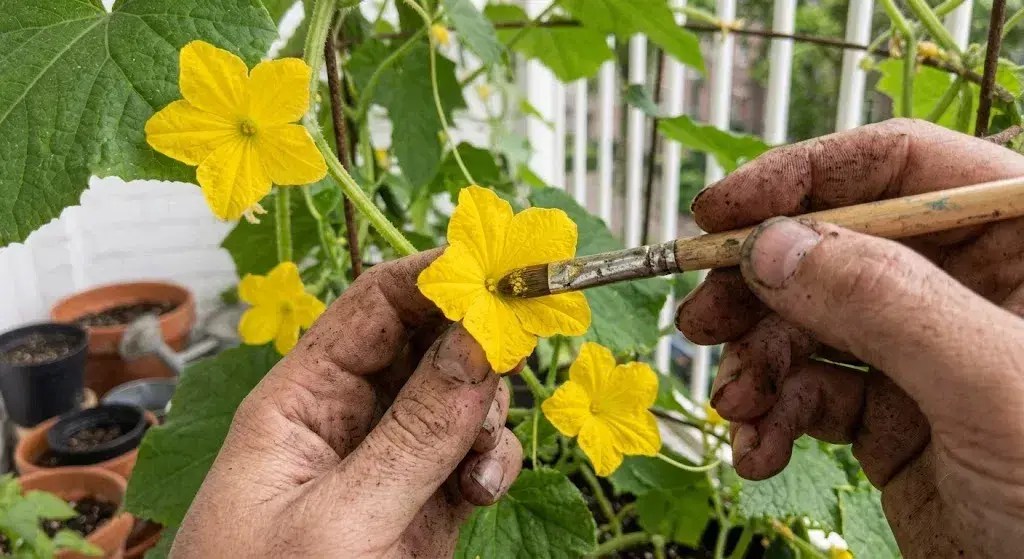
This is the reason most balcony cucumber growers get flowers but no fruit — and it has nothing to do with their trellis setup.
Cucumbers produce male and female flowers separately on the same plant. Female flowers have a tiny proto-cucumber at their base. Male flowers do not. Bees pollinate female flowers by carrying pollen from male flowers.
On a balcony, bee visits are inconsistent. You can go days without a single bee, especially on upper floors. According to Penn State Extension, hand pollination is a proven method to achieve reliable fruit set when natural pollinators are absent.
The fix is simple: Hand pollinate every morning during flowering.
Use a small clean paintbrush or cotton swab. Touch it to the centre of a fully open male flower to collect yellow pollen. Then brush it gently into the centre of an open female flower. Takes thirty seconds per flower.
Do this every morning between 7 am and 10 am when flowers are fully open. Your fruit set will match or exceed what you would get in an open garden with regular bee activity.
What to Expect — Honest Timeline
Days 1 to 7: Seeds germinate. Keep soil consistently moist and warm — cucumber seeds need soil temperature above 65°F to germinate reliably.
Weeks 2 to 3: True leaves develop. This is when to move seedlings to their final pot if started separately.
Weeks 4 to 5: Vines begin extending. Guide them into your chosen method — railing, cage, or cascade position — now, before they tangle.
Weeks 5 to 6: First male flowers appear. Do not hand pollinate yet — wait for female flowers.
Week 6 to 7: Female flowers appear. Begin hand pollination daily.
Days 50 to 65 from planting: Days 50 to 65 from planting: First cucumbers ready to harvest. If your plant looks stressed before this point, this 5-minute daily routine for balcony plants looking dead will help you catch problems early.
Harvest window: Pick cucumbers when they reach full size but before they yellow. A cucumber left on the vine too long signals the plant to stop producing. Harvest consistently every 2 to 3 days during peak production.
Frequently Asked Questions
Do bush cucumbers produce as much as vining varieties?
Per plant, vining varieties produce more total fruit. But bush varieties produce comparable amounts per square foot of space used — which is the relevant measure on a balcony. For the space a bush cucumber occupies, the yield is excellent.
Can I grow cucumbers on a balcony that gets only 4 hours of sun?
Cucumbers need a minimum of 6 hours of direct sun for reliable fruit production. At 4 hours, you will get vine growth and flowers but poor fruit set. If your balcony gets under 6 hours, grow lettuce, spinach, or herbs instead — cucumbers will disappoint you in low light.
Why are my cucumber flowers falling off without producing fruit?
Almost always a pollination issue on a balcony. Begin hand pollinating every morning as described above. Also check that temperatures are not exceeding 95°F — extreme heat causes flower drop regardless of pollination.
How often should I water balcony cucumbers?
Check soil moisture daily. Cucumbers need consistently moist soil — not wet, not dry. In hot summer weather on a balcony, this often means watering every day. Always water at the base, never overhead — wet leaves accelerate fungal disease.
Can I grow two cucumber plants in one pot?
Only in a container of 10 gallons or larger. Two plants in a 5-gallon pot compete for water and nutrients and both underperform. One plant per 5-gallon pot produces better than two plants sharing it.


